
Improve Your Decision Making and Hire Better People

I have spent much time trying to put more science and objectivity into recruitment. Unfortunately, we have based much of our decision-making and practices on assumptions, beliefs, and practices that are more akin to voodoo than science.
For example, we firmly stick with interviewing despite research from multiple sources indicating its flaws. We discount our own biases and often revel in our ability to test a candidate’s resilience or how they react under stress.
In the U.S.. we are generally reluctant to use tests of ability or skill out of unfounded fear of legal action or disparate impact. Neither of which are issues when we use properly constructed tests.
We still often say that “we know a good candidate when we see one” but cannot define or explain what “good” means. But it leads to group think and bias.
We use questionable data to “prove” the quality of hire. These include the highly subjective hiring manager’s opinion and the speed at which a person gets promoted (without any consideration of the economics of the firm or whether or not there is a realistic opening).
Our reporting metrics are primarily about activity, not quality nor do they answer why something happened or might happen.
The Evidence-Based Approach
Experts have used Evidence-based approaches for the past 20 years in medicine, engineering, and management. EBA is a systematic method to reach the best possible decision or answer to a question. One of its primary goals is to remove our tendency to make decisions using our cherished beliefs and practices that seem scientific but have never been studied.
Although more time-consuming and complex than simply using opinion or past habits, it is a better approach that integrates research and data into the recruiting process and decision-making.
The Center for Evidence-Based Management has outlined six steps defining the framework for an evidence-based approach.
Asking – the process begins by taking a practical issue or problem and turning it into an answerable question. For example, What defines the best person for a specific position? Or are interviews an effective way to assess capability and skills?
Acquiring – then the second step involves:
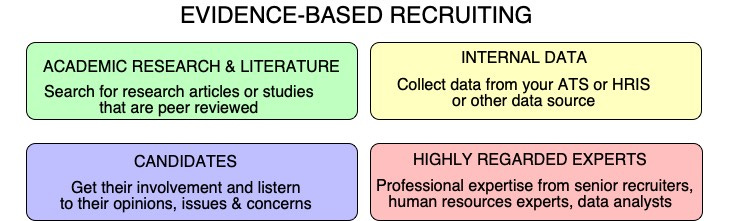
searching the scientific and academic literature to see what studies or research have been done that might answer the question.
You should also consult respected, experienced recruiters or human resource professionals who might add their experience.
You may also have data analytics from your ATS and HRIS that might shed light on the answer. For example, the data might show that the school an employee graduated from does not impact performance.
And you can ask recently hired people or candidates for their opinions, issues, or thoughts.

Appraising – This step requires you to evaluate each part of the collected data for trustworthiness, quality, and relevance. Is this data biased? Who did the research, and are they credible? Do others corroborate the research? Is there enough evidence to reach a conclusion? Do you need more research or research of a different type?
Aggregating – in the fourth step, you combine the evidence and weight it according to your practical experience, its relevance, and credibility. You must be careful here not to discard evidence you don’t like, or that doesn’t agree with your preconceived ideas.
Applying – the most relevant evidence is then incorporated into decision-making. It is helpful to have several people involved in this step so that no one person’s biases override any evidence.
Assessing – in the assessment stage, you must evaluate the outcome of the decision to see if it has accurately answered your question and improved your hiring.
Benefits
#1. It can significantly increase your credibility with management because you provide objective data for your actions.
#2. It reduces errors in judgment and helps to either validate or dispel the beliefs and assumptions you may have.
#3. It increases your confidence in the decisions you make.
Challenges
This process is not easy. There are several challenges, but they should not prevent you from trying this approach.
It takes time to conduct and evaluate the research.
There may not be sufficient objective data or research to answer your questions.
Based on the evidence, changing your behavior or that of others may be challenging. For example, as mentioned above, numerous research studies show the inadequacies of interviewing, yet it is almost universally practiced.
The time spent developing an evidence-based recruiting process will pay you back by helping you more accurately asses candidates, influence hiring managers, and improve the overall quality of your hiring process.
Example of an Evidence-Based Analysis
Company ABC
Prepared by: John Q. Smith
Question: Are candidate interviews effective ways to evaluate skills and abilities?
Academic Research
A review of three research reports shows only a weak correlation between interviews and performance. The general conclusion is that only a well-defined structured interview exceeds chance in candidate selection. It also indicates that tests of general ability and work samples exceed the value of interviews in effectiveness and validity.
Highly Regarded Experts
While our recruiters believe that it is important to interview in order to judge a candidate’s cultural fit and personality, there is little agreement on how effective interviews are. Some recruiters are adamant that interviews are good ways to assess candidates, but they have no objective evidence to prove that belief. We also interviewed ten hiring managers, and they believe that the interview is essential but only for cultural fit and personality.
Internal Data
We collected and analyzed the performance data of twenty-five hires for the past two years and compared it to their source of hire, tenure, school attended, and grade-point averages (GPA). There was a weak negative correlation between grade point averages and tenure. Those with lower GPAs tended to stay longer. There were no other significant correlations. Large data samples collected by Google have also indicated that none of these factors were significant for them.
Candidates and Recent Hires
We interviewed a dozen new hires and did an online survey of twenty people who had applied for a position. We asked the recent hires for their opinion on the usefulness, accuracy, and effectiveness of their interviews. Seven of them felt the interviews were well done and let them showcase their experience. However, the five others were surprised that they received an offer because the interviewer did not allow them to discuss what they had accomplished and instead spent time chatting about their hobbies and personal life.
All of the applicants felt that interviews were a necessary evil but did not think they were effective in fairly assessing their capabilities.
Conclusion
Overall, interviews seem inadequate to assess skills or abilities but may be useful psychologically to connect candidates with the hiring manager and help assess personality and culture fit. Interviews do not provide enough value to justify their time and cost. We recommend that all candidates take an appropriate test for the position or be willing to provide a work sample before they are selected for an interview. We recommend that those who pss these tests then have a single interview with the hiring manager. A recruiter should work with the manager to assist in creating a set of structured interview questions before the interview.
Why Upgrade to a Paid Subscription?
Each week we add content and hopefully stimulate thinking about new approaches and ideas in talent management and recruiting.
When you become a paid subscriber, you support my efforts to bring you these articles. And occasionally, I publish white papers and podcasts for paid members only.
You have my deepest thanks and appreciation if you are already a paid subscriber.
A paid subscription is only $5.00 per month/ $50 per year.
Future of Talent Weekly Newsletter is entirely supported by our readers and me.
How Are You Doing? Can I Help?
We work with many firms to:
Help them create or improve their talent strategy
Accelerate choosing & implementing technology
Improve/streamline their recruiting process
Assess their career site
Build better engagement strategies
Build less biased screening & assessment processes
I deliver keynotes and talks, create and deliver seminars and workshops, do webinars, and write branded white papers. I am also an advisor to several early-stage companies providing innovative recruitment software. To find out more visit our website or email me at kwheeler@futureoftalent.org,
Related Links
How to introduce Evidence Based Management in your organisation without pissing off your boss and colleagues. (PowerPoint Presentation)
Evidence-Based Management (HBR)
The Evidence-Based Management Guide (Whitepaper)
Recent Comments